

On July 15, DTCC converted DTC-held securities into tokens and used them in live production trades spanning collateral pledges, securities lending, repo, equity settlement and margin workflows. The exercise brought more than 30 firms into the same live production environment.
For funds and asset holders, this milestone makes financing less hypothetical. The market is already speaking as though the next step has arrived: Robinhood now promotes stock tokens as assets that can earn yield onchain or serve as collateral, while xStocks and Kamino capture the same shift in sentiment. The volume of real-world assets circulating onchain—including treasuries, equities, credit, and commodities—has surged tenfold over the last twenty-four months, with $29B now moving through decentralized rails. Yet the legal path remains far less settled than product language suggests.
Can I use onchain stocks (Ondo, xStocks, etc.) as collateral anywhere yet?
— Route 2 FI (@Route2FI) July 13, 2026
Let's say I want to hold the S&P 500 as collateral and borrow stablecoins.
As Kate McKay of TreasurySpring put it after the live trades: “Would we do this for live clients now? There is still lots to be worked through and one important aspect is legal certainty.”
Rather than considering tokenized securities as collateral in the abstract, the essential challenge is establishing a clear, enforceable path from the token to the underlying claim across transfer, default, and recovery. Five core questions reveal this pathway:
1. Identify the holder’s legal claim
The labels “tokenized stock” and “tokenized RWA” describe packaging, not a uniform set of rights. Products that look interchangeable in a wallet may give their holders entirely different claims.
The token can represent:
- direct ownership recorded by the issuer or transfer agent;
- a beneficial interest held through a broker, custodian or depository;
- a contractual claim against a platform that holds the asset;
- a redeemable receipt backed by an omnibus pool;
- a synthetic exposure that tracks the asset without conveying ownership;
- a digital twin of a position recorded somewhere else.
A token can provide useful market exposure without creating a financeable asset. Collateral analysis begins with the legal claim, not the token label. Proof of reserves, attestations and “fully backed” claims can confirm a balance at a point in time. Priority, control and recoverability require separate evidence.
A backing statement should be able to answer:
- who owns them;
- whether they’re segregated from the issuer’s or custodian’s estate;
- whether they’re pledged elsewhere;
- whether token holders have a direct proprietary claim;
- whether the assets can be delivered after default;
- whether redemption can be suspended;
- whether liabilities match the reported reserve at all times.
Trace the ownership chain
Follow the claim through every layer: Issuer → registered holder → depository or custodian → intermediary → token platform → asset holder. Each one creates a legal relationship and a possible point of failure.
The entity offering the token may not own the underlying security directly. The holder may instead have an entitlement against an intermediary, which depends on another intermediary, or a contractual redemption claim against the token issuer.
The underlying asset can retain its value even when the pledge attaches to a weaker claim than the holder expected. Collateral may attach to the token, the contractual claim, the securities entitlement or a combination of them.
Unless those rights connect cleanly, control of the token may stop before it reaches the asset beneath it. Consider the following five structural frameworks.
Issuer-sponsored tokenized securities
This structure offers the shortest legal path. The issuer or an authorized transfer agent recognizes the blockchain-based position in the official ownership record.
Technology can make the position direct while regulation still gates transfer. Check whether the blockchain is the authoritative register or an operational copy, whether an onchain transfer changes legal ownership, whether a security interest can be recorded and whether the issuer will recognize a secured party or buyer after default.
Take Franklin Templeton’s case. The fund’s transfer agent maintains the official ownership record through Franklin Templeton’s blockchain-integrated system. One BENJI token represents one fund share.
Private securities, fund interests and other regulated assets may remain limited to eligible investors, approved jurisdictions or specific trading windows. Smart contracts can automate those restrictions, but they cannot remove them.
“By ensuring assets are minted onchain, we enable true ownership, allowing them to move and settle at blockchain speed – eliminating the need for traditional infrastructure.”
Roger Bayston, Franklin Templeton Head of Digital Assets
Intermediary-based entitlements

Here, the token sits downstream from conventional market infrastructure.
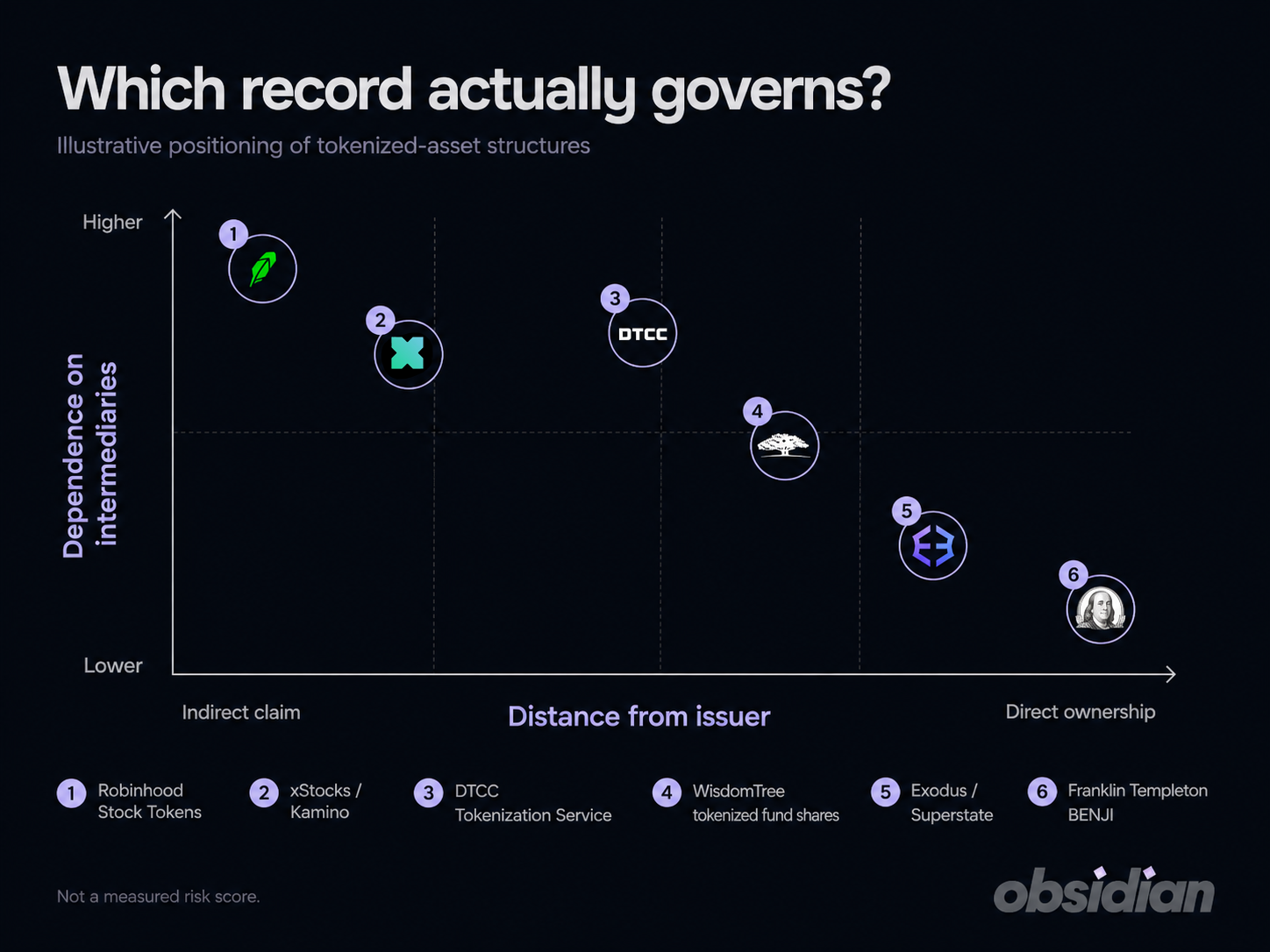
The token holder may have an entitlement against a broker, bank, custodian or tokenization platform rather than direct ownership of the registered security. Robinhood’s own documentation specifies: “you are not buying the actual stocks – you are buying tokenized contracts that follow their price”. The authoritative record remains with DTC, a transfer agent or another intermediary even though the downstream position moves onchain.
The token holder may have an entitlement against a broker, bank, custodian or tokenization platform rather than direct ownership of the registered security. Robinhood’s own documentation specifies: “you are not buying the actual stocks – you are buying tokenized contracts that follow their price”. The authoritative record remains with DTC, a transfer agent or another intermediary even though the downstream position moves onchain.
The default test is simple: can the secured party reach the underlying entitlement, or only the token that represents it?
The structure also introduces insolvency risk. If an intermediary fails, the outcome may depend on whether the underlying assets were segregated, whether the token holder’s interest can be identified and whether another creditor has a competing claim. FTX Recovery Trust is still distributing money to creditors nearly four years later, a reminder that recovery can outlast the market cycle that created the claim.
Third-party custodial tokens
A platform such as Backed may buy assets through traditional brokers, place them in regulated custody and issue tokens such as xStocks against an asset or pool.
In this category, “backed” can cover several arrangements. Assets may be held for named token holders, pooled in an omnibus account, owned by the issuer or subject to other liens and restrictions.
The documents that clarify the claim are the custody agreement, account structure, reconciliation process and redemption terms. They should also show what happens if the issuer or custodian fails.
An adequate reserve does not cure an unsecured claim against the issuer.
Synthetic tokens
A synthetic token may track the price of a stock, bond, commodity or other asset without conveying ownership of it. In Ondo’s words, “tokenized stock representations based on DTC tokenized entitlements”. For the asset holder, the price exposure may feel equivalent, but for a lender, it is not.
The relevant asset is the issuer’s promise and the support behind it. Counterparty credit, hedge performance, margin, liquidation rules and legal enforceability determine its value under stress.
Close price tracking doesn’t create a direct claim on the reference asset.
Digital twins
A digital twin mirrors an asset or position recorded elsewhere. DTC-custodied securities can move into participant wallets as tokens while remaining anchored to DTC’s infrastructure and records. DTCC describes them as representations or “digital twins” of DTC-held assets. The transfer agent records DTC’s nominee as the registered holder, while DTC and brokers maintain the downstream chain.
The key risk is synchronization. Check how the twin is issued, updated, frozen and extinguished, and which record prevails if the blockchain and source system diverge.
A twin becomes difficult collateral when both systems appear to support the same claim, or when one system does not recognize a transfer recorded by the other.
2. Find the authoritative record
Every structure relies on at least one record to establish ownership or entitlement:
- the issuer’s share register and transfer agent’s books;
- a DTC account, custodian’s sub-ledger or platform register;
- the blockchain itself.
Several records may operate together. A transfer agent may maintain the issuer’s register through a blockchain-integrated system and reconcile it against an intermediary’s books. The decisive question is which record prevails when they disagree.
The wallet may show the asset holder as owner while the transfer agent shows a nominee. A platform may record a pledge that the custodian never acknowledged. The token may move onchain while the underlying security remains locked or restricted.
Ask which record an issuer, court, custodian or insolvency administrator would treat as authoritative. Divergent answers create reconciliation risk and may reduce, or eliminate, the asset’s collateral value.
Record hierarchies in practice
Governing record | Example | What the holder owns | What happens if records conflict | Main financing dependency |
Issuer’s share register | Exodus Class A common stock | Actual Exodus shares, including shares tokenized through co-transfer agent Superstate | The tokenized position must correspond to the shares reflected in Exodus’s official share register | Recognition by the issuer and its transfer agents |
Transfer agent’s books | WisdomTree tokenized fund shares | Shares recorded through WisdomTree Transfers’ blockchain-integrated system | WisdomTree Transfers maintains the tokenized-holder record, but BNY’s fund-level records control if an inconsistency cannot be reconciled | Transfer-agent acknowledgment, reconciliation and correction procedures |
DTC or intermediary account | DTC-tokenized securities | A participant’s entitlement to securities held within DTC rather than direct registration with the issuer | DTC’s records determine participant ownership; the participant’s books identify the beneficial owner | Cooperation from DTC and the relevant broker, bank or participant |
Custodian’s sub-ledger | xStocks issued by Backed | A certificate tracking an underlying stock or ETF, rather than direct ownership of that security | The issuer’s legal documents, reserve holdings and custody records establish whether the token is properly backed | Asset segregation, custodian solvency, reconciliation and redemption |
Platform register | Robinhood Stock Tokens | A tokenized debt security issued by Robinhood Assets (Jersey), providing economic exposure but no legal or beneficial rights against the underlying company | Robinhood’s issuance and account records govern the holder’s claim against the token issuer; Apple’s or Nvidia’s shareholder register does not recognize the token holder | Platform continuity, issuer credit and contractual redemption rights |
Blockchain as the official system of record | Franklin Templeton BENJI | A share of the Franklin OnChain U.S. Government Money Fund | The fund’s transfer agent maintains the official record through the Benji blockchain-integrated system; Franklin also describes the public blockchain as the fund’s official system of record | Transfer-agent controls, approved wallets and the integrity of the blockchain-integrated register |
3. Establish control beyond the wallet
Token liquidity and claim liquidity can diverge. A token may trade actively while the underlying claim remains difficult to deliver or redeem. A marketable security can also become trapped behind a platform that pauses transfers or redemptions.
Control has two practical tests:
- Can the token be sold or transferred?
- Can the underlying claim be delivered, redeemed or enforced?
The second layer often governs assets subject to investor qualifications, jurisdictional limits, lock-ups, issuer approvals or trading windows. Onchain settlement does not override those conditions.
Wallet control is only one layer
Moving a token into a controlled wallet secures the token, not necessarily the underlying claim. Private-key control may not bind the issuer, transfer agent, custodian or intermediary, and it does not establish priority over another creditor.
Depending on the structure and jurisdiction, enforceability may also require:
- an account-control agreement;
- acknowledgment from the issuer, custodian or transfer agent;
- a contractual assignment;
- a perfected security interest;
- control through a recognized intermediary;
- a liquidation mandate or power of attorney;
- restrictions on additional liens or issuance.
The legal model determines record and control
The SEC’s Crypto Task Force written-input page brings together submissions that approach the same implementation problem from different angles. The Securities Transfer Association argues that issuer-sponsored tokens should be distinguished from third-party tokens. Persistence Analytics separates ownership, governance rights, economic exposure and liquidity, and proposes an evidence chain for implementation verification. James Johnson focuses on backing, custody, audit, redemption, bankruptcy and recovery. Ripple proposes an onchain register maintained by a regulated digital transfer agent as the authoritative legal register for directly issued tokenized securities. Vertalo’s submission adds a transfer-agent and digital-securities perspective that should be read alongside those models.
These submissions do not establish regulatory consensus. They show a market still negotiating the legal and operational architecture beneath the token. Product issuance is moving faster than the collateral framework.
4. Map the enforcement route
Collateral is designed for the moment when the borrower can no longer perform. Before financing closes, establish:
- whether the lender can freeze or move the token without borrower cooperation;
- whether the lender can redeem directly or become the recognized holder;
- Which buyers are eligible to receive it?
- Are issuer or platform approvals still required?
- How long could settlement or redemption take?
- Which events allow transfers or redemptions to be suspended?
- What happens if the issuer, custodian or platform fails first?
5. Stress-test intermediary failure
The answer determines whether the token remains usable collateral or becomes a recovery claim.
A July 21 Ocean RWA Finance release shows the same test moving into private credit. The transaction used hash references on Avalanche while keeping invoices, trade documents and counterparty information in controlled off-chain channels.
That may strengthen document integrity and review workflow. It does not replace the credit file. A financing provider would still need the legal transfer instrument, valuation method, disclosure rights, eligibility limits, control path and default mechanics.
Build the evidence file
Tokenization can improve transferability, settlement speed, transparency and automation. Those benefits help, but the financing decision still runs through the full chain:
Legal claim → governing record → control → enforcement → recovery after failure
Use those five questions as the evidence map. A valuable token may still fail as collateral when any answer remains opaque or unenforceable. Present the structure, not the label.
A decision-ready package should identify:
- What does the holder legally own, and through which intermediaries?
- Which system establishes and governs ownership or entitlement?
- Who can transfer, freeze, pledge or redeem it?
- What allows the lender to take control and liquidate after default?
- What survives if the borrower, issuer, custodian or platform fails?
Support the map with issuer confirmations, transfer-agent records, custody statements, account agreements, legal opinions, lien searches, smart-contract audits, reserve reconciliations and tested recovery procedures.
No single document answers all five questions. A complete file lets each counterparty assess the claim, identify the remaining risks and reach its own conclusion.